
Lotus App
Lotus is a mock trans wellness application that centralizes physical, geographical, and digital resources for gender non-conforming individuals. This independent class project not only involved developing a brand for the app, but also a mid to high fidelity prototype that involves three user flows.
Purpose
The purpose of the Lotus project is to address the wave of anti-trans legislation in the United States within recent years by providing a centralized hub of trans resources. In 2023 alone, there were a total of 85 anti-trans bills passed with 375 anti-trans bills still active (Trans Legislation Tracker). A common example of transgender discrimination on a legislative level are the implementation of public bathroom bans. This practice bans transgender individuals from using the bathroom that aligns with there gender identity. As of 2026, 21 states have legislative bathroom bans that involve K-12 schools, directly targeting transgender youth. Florida, Idaho, Kansas, and Utah have the most extreme restrictions, allowing for criminal offense for transgender individuals to use the bathroom of their gender identity (Movement Advancement Project). This exponential increase in anti-transgender legislation can cause distress and even the feeling of hopelessness for trans individuals. Having a dedicated and centralized resource is essential in providing aid to the transgender community, allowing trans folk to access resources regardless of state restrictions.
Research
In order to build an health-based app, it is important to conduct a competitive analysis of preexisting health-based applications that already exist. This allows us to get a comprehensive overview of what resources are necessary to implement into the Lotus app while avoiding their pain points.
For our competitive analysis, we will be focusing on the following four apps:
-
Apple Health
-
A physical health app that serves to provide summaries of a user’s health represented by steps, calorie burning, distance walked and ran, audio exposure, menstrual cycle and sleep patterns.
-
-
Smoke Free
-
SmokeFree is made to help users quit smoking cigarettes or tobacco rolls. Unfortunately, this application does not account for vaping, smoking marijuana, or any other addictive substance.
-
-
Headspace
-
Headspace is a wellness app the prioritizes the mental health of its users through the use of daily meditation and mindfulness activities.
-
-
NTC (Nike)
-
A physical health app, but unlike Apple Health it is more focused on providing users with workout routines along with tracking day to day activities.
-
Competitive Analysis
For my competitive analysis, I first started by making a content inventory of notable features of all four health-based applications. I then created a google spreadsheet that compares all of these features to one another.

Takeaways
-
No infinite scroll
-
Promotes users to step away and focus on user's self wants and needs outside of an application.
-
-
Personalization & Progression
-
A users interface should be dependent on the user's needs. A great opportunity to introduce this is through personalized registration and content. Gamification can allow users to feel a sense of progression and return for daily logins without excessive screen time.
-
-
Imagery
-
To keep users engaged, we can use imagery such as graphs, maps, and book covers to illustrate resources.
-
-
Free vs Premium
-
Accessibility to resources is not only dependent on physical limitations, but also monetary restrictions. For this project, it is important to keep access to these resources and affordable and free when possible.
-
Mood board
This mood board establishes the Lotus application's color palette, typography, and a mobile bottom navigation element. I also included problem statements and references to other applications that I used for my competitive analysis.
Lotus Mood board

Lotus Type Experimentation

Reference Board

Logo design
For the final logo, I decided to go for a minimal wordmark that utilizes the Shrikhand typeface. This font has a nice balance between decorative elements while also retaining readability. This font also pairs well with the Proxima Nova typeface, which will serve as the primary paragraph and secondary headers of the application. The logo design iterations primarily included different strokes, fills, font experimentation, and backgrounds. In the end, I decided to move forward with a more simple design to focus on later user flows.

Lotus wordmark iterations
Personas
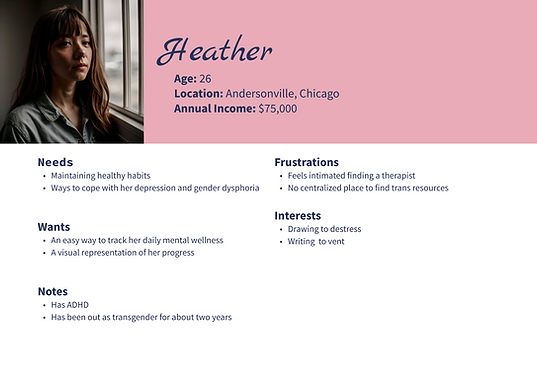
When creating these personas, it was important to develop and visualize our target audience. Our target audience focuses on American transgender young adults who's mental health are being impacted from current anti-trans legislation. Each persona provides a mini biography which includes their age, location, and annual income to visualize access and demographic. Following this, each persona also includes the users needs, wants, frustrations, interests, and additional notes that do not fit into these categories. Lastly, each persona has an AI generated (Fotor) headshot to visualize what these personas could look like.
For our two main personas, we will be looking at Heather and David.
Heather
-
Needs
-
Maintaining healthy habits
-
Ways to cope with her depression and gender dysphoria
-
-
Wants
-
An easy way to track her daily mental wellness
-
A visual representation of her progress
-
-
Frustrations
-
Feels intimated from finding a therapist
-
No centralized place to find trans resources
-
-
Interests
-
Drawing to destress
-
Writing to vent
-
-
Notes
-
Has ADHD
-
Has been out as transgender for about two years
-
David
-
Needs
-
Ways to feel more comfortable within their gender identity while still in the closet
-
A safe space to explore trans culture
-
-
Wants
-
To find online resources regarding gender identity
-
A way to find an online community
-
-
Frustrations
-
Lacks trans resources in their area
-
Prefers writing out their feelings as opposed to typing
-
-
Interests
-
Reading trans memoirs
-
Browsing the internet
-
-
Notes
-
Still figuring out their gender identity
-
Has recently found out that they are not cisgender
-
Heather's Persona
David's Persona

User flows & Stories
Three user flows were designed prior to developing the Lotus prototype. Each user flow has a persona in mind, with one user flow developed without a visual persona, but will be going by the name Miles. With each user flow, there is also a story associated with a persona to go over how each persona would interact with the Lotus app.
Miles & the resource map
-
He can use the Lotus app resource map and filter to find health clinics, resource centers, and support groups for transgender youth. Miles can schedule and contact clinics directly through the app. Miles can find a community through the Lotus discussion board, which is moderated to ensure a safe and welcoming environment for LGBTQAI+ users.
Heather & the daily journal
-
She can use the Lotus app to find resources on managing her depression, which can be a toggleable overlay for the health calendar previously mentioned. This creates a centralized place for mental wellness and healthy habits customized to the user's needs.
David & online reading materials
-
David lives in a small rural town outside of Memphis, Tennessee. They are not ready to visit trans friendly establishments out of fear of being outed to his peers. David can use the Lotus app to find online trans resources such as articles regarding managing gender dysphoria and discover what it means to be trans.
Resource map user flow

Daily journal user flow

Online reading materials user flow

Prototype
Prototype
This mid-to-high fidelity prototype was created using Figma with a focus on usability on a mobile device. This prototype features three user flows, one for each major feature.
Resource Map
-
A geographical map with push pins representing trans friendly establishments
-
Has a review and rating system to allow for LGBTQAI+ specific feedback
-
Would use an API such as Google Maps or Leaflet
Daily Journal
-
A two part check starting with a rating system based on customized subject areas such as gender dysphoria or anxiety. Next, users are prompted with a open text response section that allows users to journal by typing, writing, or drawing based on user preference.
-
Allows users to document daily progress based on user customization
-
Visualizes user's monthly progress based on daily journals with a color coded calendar
Online Reading Materials
-
A centralized database for LGBTQAI+ specific reading material varying in medium such as medical journals, memoirs, and mental health resources.
-
Users a search, browse, and filter system to allow customization content
-
Allows users to easily save and share resources
Credits
Research
-
“2023 Anti-Trans Bills: Trans Legislation Tracker.” 2023 Anti-Trans Bills: Trans Legislation Tracker, translegislation.com/. Accessed 15 Nov. 2023.
-
“Bans on Transgender People Using Bathrooms and Facilities According to Their Gender Identity.” Movement Advancement Project, www.lgbtmap.org/equality-maps/nondiscrimination/bathroom_bans. Accessed 15 Nov. 2023
Competitive Analysis
-
Apps researched
-
Apple. “Health App.” Apple, 2024, www.apple.com/health/.
-
NIKE. “Nike Training Club App. Home Workouts & More.” Nike.com, 2025, www.nike.com/ntc-app.
-
smokefree.gov. “Home.” Smokefree.gov, smokefree.gov/.
-
Headspace. “Meditation and Mindfulness Made Simple - Headspace.” Headspace, 2024, www.headspace.com/.
-
-
Medium used to create competitive analysis
-
Google. “Google Sheets: Free Online Spreadsheets for Personal Use.” Google.com, 2014, docs.google.com/spreadsheets/u/0/.
-
Persona Headshots
-
Medium used to create persona headshots
-
“AI Image Generator - Text to Image Online for Free | Fotor.” www.fotor.com, www.fotor.com/ai-image-generator/.
-
Mood board, Logo design, personas, user flows, and prototype
-
Medium used to create above assets
-
Figma. “Figma: The Collaborative Interface Design Tool.” Figma, 2025, www.figma.com/.
-
-
Iconography used for mood board and prototype
-
Google. “Google Fonts.” Google Fonts, fonts.google.com/icons.
-
-
Geographical imagery used for prototype
-
Google Maps. “Google Maps.” Google Maps, Google, 2025, www.google.com/maps.
-
-
Fonts used
-
Header & Wordmark: Shrikhand
-
Pinhorn, Jonny. Shrikhand, fonts.google.com/specimen/Shrikhand.
-
-
Body: Proxima Nova
-
Simonson, Mark. Proxima Nova, fonts.adobe.com/fonts/proxima-nova.
-
-